Saturday, December 11, 2010

fast honda cars

honda cars
honda cars

honda cars
honda cars

honda cars collection

honda cars
honda cars
honda cars
honda cars
honda cars

Amazing Honda Cars

honda cars
honda cars
honda cars
honda cars

subaru impreza top cars

subaru impreza
subaru impreza
subaru impreza
subaru impreza

top honda cars


It gets harder and harder to impress consumers these days. However, your PA dealers are certain that the new commercial for the Insight – one of the newest and most buzz-worthy Honda cars on the market – is going to garner some attention.
The new commercial for these hybrids looks as though hundreds of Honda cars are parked in the desert and they rhythmically shine their headlights to create shapes and animations. The animations go from a smiley face to hearts to the new symbol for the Insight hybrid.
Much like the viral “electric sheep” commercial that circulated around the Internet, however, nobody is really sure if these Honda cars in the ad are real and electronically linked together or if it is simply computer animation. Regardless of if it is real or not, the commercial is certainly attention-grabbing and serves its purpose of making people talk about it. Once people talk about the ad, they start talking about the product in the ad, which is the Honda Insight in this case.

honda cars
honda cars
honda cars
honda cars

Tuesday, December 7, 2010

Lancia Delta Cars

lancia delta
lancia delta
lancia delta
lancia delta
lancia delta

honda cars corporation

Honda Cars Philippines, Inc. bares plans to adjust prices of its multi-awarded compact sedan, Honda Civic. Since its introduction in 2006, the 8th generation Civic has rocketed sales charts and has consistently gained market leadership in its class. To date, the Civic has been well received by almost 18,000 happy customers. Due to increased production cost brought about by the weakening of local currency, Honda plans to bring Civic prices to normal levels. Effective December 01, 2008, price of all Civic models will increase by P20,000. Base model Civic 1.8V with manual transmission will be priced Php 830,000. The best-selling variant, Civic 1.8S with automatic transmission will be priced Php 919,000 while its top of the line variant 2.0SL with automatic transmission will be priced Php 1,150,000

honda cars
honda cars
honda cars
honda cars
honda cars

The Lorinser-Tuned Mercedes-Benz SL-Class Makes World Debut

The Lorinser-Tuned Mercedes-Benz SL-Class Makes World Debut
The Lorinser Mercedes-Benz SL-Class, exterior front and side view

In keeping with the day's Mercedes tuning theme, Lorinser over the weekend unveiled a new aerodynamic body kit for the recently updated Mercedes SL-Class. Highlights of the package include a new front spoiler and bumper, new side skirts and a new rear apron, while two dual exhaust tips also aim to improve the sporty character of the model.

Completing their SL kit, Lorinser added a set of RS 9 wheels with corresponding wider tires, and last but not least, they lowered the roadster, thus improving both its appearance and handling attributes.

Look for a Lorinser engine optimization program for the updated Mercedes SL in the near future; but in the meantime, keep scrolling to see a number of photos showcasing the company's SL aero kit (click any photo to enlarge) along with the official press release detailing the various modifications made to the model.

Enjoy.


The Lorinser Mercedes-Benz SL-Class, exterior front view

The Lorinser Mercedes-Benz SL-Class, exterior front and side view

The Lorinser Mercedes-Benz SL-Class, exterior rear and side view

The Lorinser Mercedes-Benz SL-Class, exterior front wheel arch


Re-capturing the myth: Lorinser reveals its re-interpretation of the latest SL

As early as back in the Fifties, a major car magazine wrote: “The Mercedes SL is the most cultivated and at the same time most fascinating among the sports cars of our time”. With the most recent facelift from Stuttgart, the myth is more alive than ever. Sportservice Lorinser has reset the jewel among sports cars: the aerodynamic body parts of the Swabian vehicle customiser are fascinatingly reminiscent of the original racing car character, when the letters SL still stood for “Sport Light”.

The front is shaped by a new spoiler bumper that is characterised by three giant openings with racing grill inserts as well as a blade shaped spoiler hung below in the middle. The integrated end-to-end lip flows seamlessly into the widely flared Lorinser fender. Its slanted, larger air inlets represent the aura of the original even more strongly than the already successful series version. Additional distinctive elements of the side line are the new side skirts that are also characterised in the rear part by large air openings. In addition, its contours take in the swing of the doors and bring the SL optically nearer the ground in combination with Lorinser’s lowering. In addition, the sports car is even a touch more connected with the ground when it comes to extreme driving situations and isn’t put off by any bend.

The outstanding driving qualities also include wide tyres and remarkable light-alloy wheels. The RS 9 wheel is full of energy, and this central theme also applies especially to the design of the rear of the vehicle: while the series model tends to appear rather simple here, the Lorinser spoiler bumper draws a great deal of power from its strong contours. The observer here not only immediately notices the diffuser inset with sporty grill, but also the sculpturally moulded semi-gondolas. They house the end tips of the exhaust system with their four openings. It’s clear that the Roadster not only produces hot air, but is also developing a gigantic forward thrust. Drivers that aren’t satisfied with potent series engines can soon look forward to an optimisation from Lorinser engineers. However, a more sporty and elegant interior can be ordered there already.

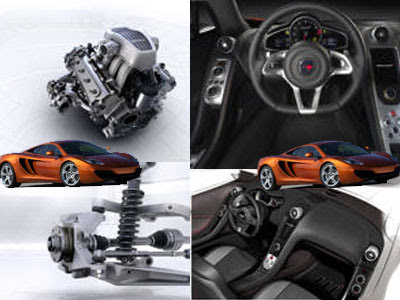
2011 McLaren MP4-12C car Gallery

2011 McLaren MP4-12C Gallery2011 McLaren MP4-12C

The independent car division based at the McLaren Technology Centre in Woking, England,the McLaren MP4-12C is revealed as the first in a range of high-performance sports cars from McLaren Automotive.The 12C, and future models within the range, will challenge the world's best sports cars, benefiting from the expertise and virtuosity of the McLaren Group.
Through a rich modern history, McLaren's automotive division has already built the world's most critically acclaimed supercar, the McLaren F1 (1993-1998) and the world's best-selling luxury supercar, the Mercedes-Benz SLR McLaren (2003-2009). McLaren Automotive now looks to the future with a new range of revolutionary sports cars.
At its heart, the McLaren MP4-12C features a revolutionary carbon fibre chassis structure, the Carbon MonoCell: the first time a car in this market segment is based around such a strong and lightweight racing car engineering solution and the first time any car has ever featured a one-piece carbon fibre structure.

2011 McLaren MP4-12C Gallery2011 McLaren MP4-12C

Martin Whitmarsh : "McLaren has for years offered a potent mix of race car and road car technologies. This combination of McLaren's performance heritage, and future demands on what is expected of high performance sports cars in the 21st century, gave us a head-start when we embarked on this project. The 12C, and future variants, draws on the spirit of Formula 1 and delivers real-world technological advances."
The first car from the new company, the McLaren MP4-12C, is a high performance two-seat mid-engine model in the 'core' sports car market segment for cars costing between £125,000 and £175,000.It goes on sale through a dedicated, worldwide retailer network in early 2011.
All the parts of the McLaren MP4-12C are bespoke and unique to this car. Everything from the engine right down to the tailor-made switches and buttons is pure McLaren: nothing has come from another manufacturer's parts bin.
The 12C is powered by a bespoke McLaren 'M838T' 3.8 litre, V8 twin-turbo engine producing around 600bhp, driving through a McLaren seven speed Seamless Shift dual clutch gearbox (SSG). It is targeting not only new standards for power and performance in its sector, but also class-leading fuel economy and CO2 emissions; supported by McLaren's experience of active aerodynamics to aid cooling, grip, handling and road holding.

2011 McLaren MP4-12C Gallery
2011 McLaren MP4-12C

"The 12C is all about performance," said Sheriff. "And in McLaren, we have a very broad definition of performance. We don't just look at the traditional one-dimensional parameters like top speed, we focus equally on useable measures such as in-gear acceleration times, braking performance in all conditions, and efficiency of power delivery combined with the lowest possible fuel consumption and CO2 emissions. Sure, 12C is very fast, but it is also the most efficient, most driveable high-performance sports car in the world.
Thorough engineering and market research led to concept development and a clear decision in favour of a mid-engined two door high performance sports car. Intensive work was carried out in the wind tunnel and the driving simulator to ensure that the new car would inherently have superb dynamic qualities.
The McLaren MP4-12C design follows similar principles to McLaren's Formula 1 cars, and the legendary McLaren F1, where everything is for a reason and all lines, surfaces, and details are designed with a job in mind as much as styled. This ensures that the 12C communicates its engineering through its styling and will remain timeless as a piece of automotive design.
"By the time the 12C is launched in 2011 we expect the economic conditions to be much improved. We have already seen significant interest in the car and the supply of the 12C will be relatively scarce; in its first year we plan to produce just 1,000 cars which represents only 3.5 per cent of the 'core' market," explained Antony Sheriff.

2011 McLaren MP4-12C Gallery2011 McLaren MP4-12C

The McLaren MP4-12C is powered by a twin-turbocharged, 3.8 litre 90° V8 engine - the 'M838T'. This marks the start of a new era in 'core' segment sports cars - smaller capacity, lighter weight, higher efficiency and more economical power units. The engine has the highest specific power output in its segment which, when allied to its low weight carbon composite chassis, delivers exemplary power- and torque-to-weight ratios.The McLaren engine revs to 8,500rpm, has quick transient throttle response and delivers its abundant torque throughout the rev range. A staggering 80 per cent of torque is available at below 2,000rpm, ensuring great driveability and no need to floor the throttle to deliver performance.
The McLaren MP4-12C has been designed around a demanding mechanical package that puts emphasis on aerodynamics, compact dimensions, performance and efficiency, practicality and comfort. Although the design of the 12C was driven by aerodynamics, it aims to remain contemporary and elegant throughout its lifetime as well as distinctive among its peers.
"The 12C design was therefore led by aerodynamics. At McLaren we have been able to use the Formula 1 techniques and the huge expertise that the company has amassed at the pinnacle of the sport," explained Stephenson.

2011 McLaren MP4-12C Gallery2011 McLaren MP4-12C

Aerodynamic efficiency drove the 12C's design. High downforce helps maintain traction, cornering ability and stability while low drag aids top speed and acceleration. It has a completely flat underbody and smooth upper body surfaces to yield a highly effective drag coefficient and generate very high levels of balanced downforce at high speed

lorinser mercedes cars gallery

Think back a little more than ten months ago and you may remember a new Lorinser tuning package we told you about aimed at enhancing the already capable Mercedes C-Class. If you can't remember, not to worry, because earlier this week Lorinser released the details of the same tuning program yet again. If you didn't catch it the first time around, here's what you missed.

Outside, the typical Lorinser fare is all present. This includes a new front and rear apron, side skirts, 19-inch light alloy wheels, and a new distinctly shaped sport exhaust system. Under the hood, power's been boosted from the C350's factory 200 kW/272 hp to 224 kW/305 hp, while torque jumps from 350Nm to 380Nm. And inside, a range of interior appointments are available all emblazoned with the Lorinser logo, including custom floor mats and leather seating.

It's a tasteful package – one that adds an air of exclusivity without compromising the C's original integrity. To see it in action, keep scrolling for a wealth of high resolution photos highlighting the Lorinser Mercedes C-Class from various-yet-equally-attractive angles (click any photo to enlarge).

lorinser mercedes
lorinser mercedes
lorinser mercedes
lorinser mercedes
lorinser mercedes

Monday, December 6, 2010

World Best Proton Cars

New Proton Saga - Front 3/4
new Proton
This is probably the most anticipated car in the history that I have had this blog running, the car that will mark the retirement of the old Proton Saga and mark the beginning of a new saga in the history of Proton. It is what both we and Proton call “the People’s Car”.
It is the car that signifies Proton is going back to the basics and fulfilling its responsibility as the national car manufacturer to actually produce national cars that the majority of the people actually need – a cheap, economical run-about car with a sedan bodystyle.
That car is the new second generation 2008 Proton Saga, known to us for the past few months as the Proton BLM.

New Proton Saga - rear three quarter

As most of you should know by now, the new Proton Saga was engineered from the Proton Savvy’s platform, by a team that was led by Proton engineers together with external consultants, including LG CNS. It was developed in a record period of 17 months from the design freeze stage to the SOP stage. It was designed to be a simple, affordable and practical entry level sedan. You could call it the people’s car if you wish, something the original Volkswagen Beetle was a long time ago.
Proton decided to do away with any attempts at making this car “different”, from the beginning it was decided that its design was to be smart and simple. The front features a hexagonal mesh front grille, swept-back headlamps, and prominent lower air intakes on the bumper, while the rear of the car features wraparound crystal cluster lights and a concave boot lid. From the side you can see prominent wheel arches, which give the car a sportier look.
Thankfully, there are no design quirkiness to be seen, and the car lacks the typical hatch turned sedan awkward look that the Suzuki Swift Sedan and the Nissan Latio have.
For a small sedan like the Saga, what many will be looking at is how much interior space it has. So let’s have a look at how the new Proton fares in that area.
New Proton Saga - Interior Table
New Proton Saga - Exterior Dimensions Table
The new Proton Saga is bigger than its predecessor in pretty much every way possible. You’ll probably be able to guess what cars Competitor M and Competitor V are. Numbers are good, but they remain just figures on a piece of paper until you actually try getting into the car.
Proton

Here we have regular PAULTAN.ORG contributor Shannon Teoh in the rear seat of the car. You can see clearly the legroom and headroom available to the rear passenger – surprisingly good! The only concern would be the width of the car, it is narrower but acceptable given that this is a small B-segment sedan.
Either 2 adults or 3 children will sit comfortably in the rear bench, and there are seatbelts for 3 people, so if the government enforces the rear seatbelt rule anytime soon, the Proton Saga will be ready for it.
Proton

Interior conveniences include two cupholders in the front, one cupholder in the rear, an open storage compartment where the passenger airbag would be expected to be, a glove compartment, two rear bottle holders, door pockets on each door, seatback pockets, a 1-DIN storage area below the 1-DIN CD player, and finally a little compartment just below the steering wheel column.
Power outletThe Proton Saga has a standard car power outlet socket positioned at a 90 degree horizontal angle just below the air conditioning controls. This might cause a problem with some of the longer devices that you might want to insert into the socket, like mobile phone chargers and etc, as it might get into the way of the gear lever. If you have drinks in the front cupholders, these might obstruct the power outlet as well.
The air conditioning controls themselves (click image on the left to enlarge) are very simple and intuitively designed. This is an improvement over the Proton Personhttp://carsonedesign.blogspot.com/a’s air conditioning controls where the temperature dial was somewhat confusing. Previously readers who have seen the dials have said they look like they were recycled from the old Mitsubishi-generation Protons, but these are new stepped dials. I’m not sure what the proper term is, but it means that when you twist the dial, you feel feedback from the dials, they “click” from setting to setting, while the old dials in the Saga/Iswara/Satria/Wira were stepless, you just twisted them around and they don’t give any feedback as to whether you’ve actually achieved anything or not.
The only stepless dial is the one where you control whether the air conditioning system recirculates the air or takes in fresh air from outside. This has been made into a dial instead of a button of sorts because the control actually requires the action of you twisting the knob to close the external air intake vent – basically its a manual system.
Proton Saga Air Conditioning Vents
The air conditioning vents integrate angle and open/close functions in a single action, much like the ones on the Satria Neo. The dashboard plastics do not fall into the soft touch category, but Proton has added texture so that they do not look or feel cheap, and I appreciate that thought. I do not really have a problem with the plastics. The stepped dials and switches do not have a cheap feel to them, and all of them provide feedback as to whether you’ve actually pressed them, which is an improvement over the Persona’s feedbackless dashboard buttons.
The switches, knobs and dials are all placed in intuitive positions. My only issue with the interior is not something major. It’s just that Proton does not seem to have a standard Human Interface Design template for their interiors. A little button with a dot on it activates the central locking system in the Proton Persona, but the same button in the Saga is used to deactivate the alarm system! The same design, but different meanings in different cars. This will have to change in the next generation of cars.
Proton Saga Clarion Head Unit
Audio is provided by a single CD Clarion head unit, and either 2 speakers for the N-Line and B-Line, or 4 speakers for the M-Line. The silver head unit lights up with red backlighting, matching the rest of the car.
I wish Proton has specified to Clarion that the volume knob be on the right side of the head unit instead of on the left, as this is a right hand drive market. If you notice, the Clarion 2-DIN head unit used in the Mitsubishi-generation Protons and the Waja had the volume knob on the right. Nevertheless, the audio output through the speakers was rather decent, but being a 1-DIN unit there will be many who will swap everything out for their own custom ICE setup.
I am not completely sure, but I reckon that if you take out the 1-DIN storage compartment module from below the 1-DIN head unit, you’ll probably be able to install a 2-DIN unit.
New Proton Saga - Dashboard
Click to enlarge
The picture above shows how the front passenger area of the Proton Saga would typically be looking like. The passenger’s legs are in the photo to let you judge the interior width of the car better. The driving position for both the manual and automatic versions were decent without issues.
Proton Saga Manual ShifterFor the manual version, the clutch pedal was adequately spaced away from the brake and accelerator pedals, unlike some previous Protons. The automatic shifter uses the P-R-N-D-3-2-L shift pattern – no shiftronic-like features here.
The manual shifter is really something I’ve never seen before! The shift lever is so tall and the shift throw is rather long. The high position of the shift knob shortens the distance your hand has to travel from steering wheel to shifter, so many it was intentional. The lever’s free play both in neutral and in gear was also quite noticable, and it all reminded me of a pickup truck’s manual shift lever, although the lever did not vibrate like how a pick up truck’s normally would. Shifts felt rubbery and disconnected, not very fun but nevertheless it gets the job done.
Clutch engagement and disengagement for the manual transmission happens quite far into the clutch release. It should be quite safe if you accidentally shift without pressing the clutch pedal to the very deepest, as somewhere past mid point the clutch would have already fully disengaged.
Proton
Click to enlarge
On to the new Proton Saga’s best kept secret. The new 1.3 liter Campro IAFM engine. Let’s get to the low down on whats changed since the last iteration of the Campro 1.3 found in the Proton Satria Neo. Firstly, the manual gearbox that comes with this engine is now sourced from Aichi Kikai instead of Mitsubishi, which Proton engineers say allows them greater flexibility in specifying gear ratios, something that Mitsubishi did not provide.
Next, the engine has an Integrated Air Fuel Module which integrates a variable length intake manifold system. I will not go into lengths explaining what a variable length intake manifold system is since I have already done that before (click here to read).
The electrical system has also been updated. Ignition now uses coil-on-plug ignition, which eliminates spark plug cables from the ignition system. This eliminates some power losses caused by spark plug cables. The starter is now of a smaller physical size, but has a bigger capacity. If you listen to how this Campro IAFM 1.3 engine starts compared to the Campro 1.3 in the Satria Neo, you can hear the difference. Think of how the Perdana V6 sounds like when it starts.
The Campro IAFM engine keeps the Campro 1.3’s 94 horsepower at 6,000rpm and 120Nm of torque at 4,000rpm figures, with changes only to the way the power and torque is delivered instead of any change in the peak power and torque. Proton’s dyno tests of the new Campro IAFM engine reveals power ratings of up to 98 horsepower is achievable, but Proton prefers to publish the power figures in brochures at 94 horses for some reason, perhaps for consistency sake as not all engines may be able to achieve the 98 horses figure.

Proton
Proton
Proton
Proton
Proton
Proton
Proton